
Anticholinergic and benzodiazepine medication use and risk of incident dementia: a UK cohort study
- PMID: 31638906
- PMCID: PMC6802337
- DOI: 10.1186/s12877-019-1280-2
Anticholinergic and benzodiazepine medication use and risk of incident dementia: a UK cohort study
Abstract
Background: Studies suggest that anticholinergic medication or benzodiazepine use could increase dementia risk. We tested this hypothesis using data from a UK cohort study.
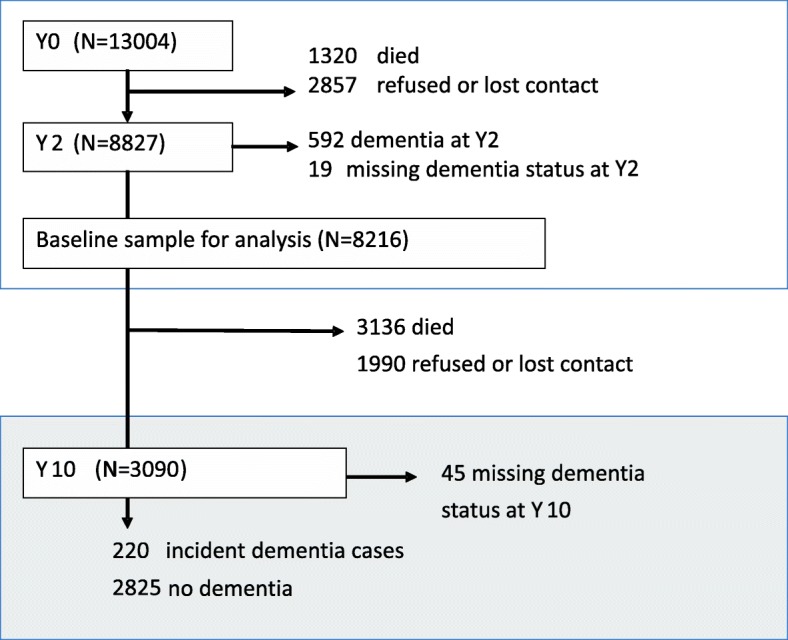
Methods: We used data from the baseline (Y0), 2-year (Y2) and 10-year (Y10) waves of the Medical Research Council Cognitive Function and Ageing Study. Participants without dementia at Y2 were included (n = 8216). Use of benzodiazepines (including nonbenzodiazepine Z-drugs), anticholinergics with score 3 (ACB3) and anticholinergics with score 1 or 2 (ACB12) according to the Anticholinergic Cognitive Burden scale were coded as ever use (use at Y0 or Y2), recurrent use (Y0 and Y2), new use (Y2, but not Y0) or discontinued use (Y0, but not Y2). The outcome was incident dementia by Y10. Incidence rate ratios (IRR) were estimated using Poisson regression adjusted for potential confounders. Pre-planned subgroup analyses were conducted by age, sex and Y2 Mini-Mental State Examination (MMSE) score.
Results: Dementia incidence was 9.3% (N = 220 cases) between Y2 and Y10. The adjusted IRRs (95%CI) of developing dementia were 1.06 (0.72, 1.60), 1.28 (0.82, 2.00) and 0.89 (0.68, 1.17) for benzodiazepines, ACB3 and ACB12 ever-users compared with non-users. For recurrent users the respective IRRs were 1.30 (0.79, 2.14), 1.68 (1.00, 2.82) and 0.95 (0.71, 1.28). ACB3 ever-use was associated with dementia among those with Y2 MMSE> 25 (IRR = 2.28 [1.32-3.92]), but not if Y2 MMSE≤25 (IRR = 0.94 [0.51-1.73]).
Conclusions: Neither benzodiazepines nor ACB12 medications were associated with dementia. Recurrent use of ACB3 anticholinergics was associated with dementia, particularly in those with good baseline cognitive function. The long-term prescribing of anticholinergics should be avoided in older people.
Keywords: Alzheimer disease; Benzodiazepines; Cholinergic antagonists; Cognition; Cohort study; Dementia.
Conflict of interest statement
The authors declare that they have no competing interests, other than IM has received personal fees for guest lectures and to support travel from Astellas Pharmaceuticals; YL reports personal fees from Thame Pharmaceuticals, NC and CF have received grants and personal fees from Astellas Pharmaceuticals.
Figures
Comment in
-
Re: Anticholinergic and Benzodiazepine Medication Use and Risk of Incident Dementia: A UK Cohort Study.J Urol. 2020 Jun;203(6):1041. doi: 10.1097/JU.0000000000000987.02. Epub 2020 Mar 17. J Urol. 2020. PMID: 32182176 No abstract available.
References
-
- Livingston Gill, Sommerlad Andrew, Orgeta Vasiliki, Costafreda Sergi G, Huntley Jonathan, Ames David, Ballard Clive, Banerjee Sube, Burns Alistair, Cohen-Mansfield Jiska, Cooper Claudia, Fox Nick, Gitlin Laura N, Howard Robert, Kales Helen C, Larson Eric B, Ritchie Karen, Rockwood Kenneth, Sampson Elizabeth L, Samus Quincy, Schneider Lon S, Selbæk Geir, Teri Linda, Mukadam Naaheed. Dementia prevention, intervention, and care. The Lancet. 2017;390(10113):2673–2734. doi: 10.1016/S0140-6736(17)31363-6. - DOI - PubMed
-
- Tannenbaum C, Paquette A, Hilmer S, Holroyd-Leduc J, Carnahan R. A systematic review of amnestic and non-amnestic mild cognitive impairment induced by anticholinergic, antihistamine. GABAergic Opioid Drugs Drugs Aging. 2012;29:639–658. - PubMed
-
- National Institute for Health and Care Excellence. Urinary incontinence in women: management. NICE guideline CG171. 2015. https://www.nice.org.uk/guidance/cg171?unlid=. Accessed 10 Feb 2017.
Publication types
MeSH terms
Substances
Grants and funding
LinkOut - more resources
Full Text Sources
Medical